Developed as a homologation model for the FIA GT3 class, the 996 GT3 was, from the very beginning, a no-compromise design. Chief developer Roland Kussmaul and test driver Walter Röhrl worked together to create a race car with street legality. The result exceeded all expectations: Röhrl set a Nürburgring Nordschleife record of 7 minutes and 56 seconds with the car—the first street-legal vehicle ever to break the eight-minute barrier. The 996 GT3 reaches
a top speed of 300 kph (Vmax: 302 kph).
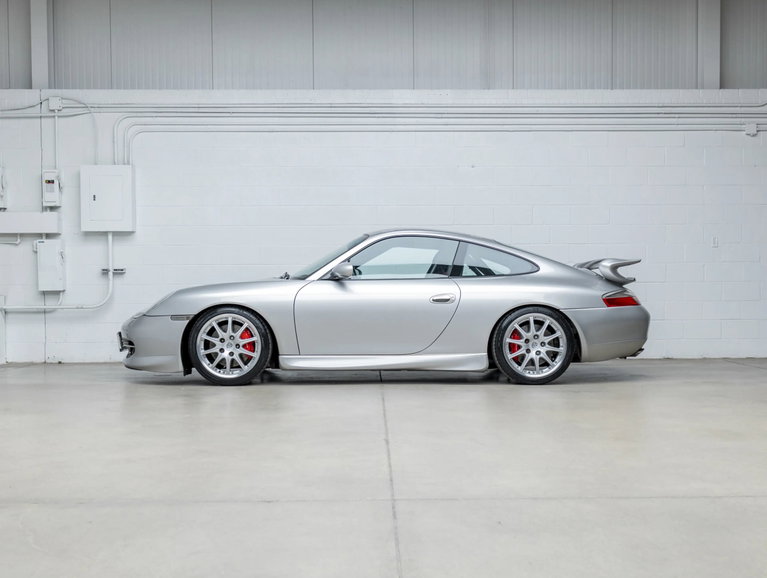
The world premiere at the Geneva Motor Show is the GT3, a Clubsport model—painted in Arctic Silver, with the license plate S-WR 996. Walter Röhrl subsequently used this car as his personal company car for more than 20 years.
These figures refer to the following specifications; the Porsche is the
Clubsport variant.
The Mezger Engine: Racing DNA in a Road Car
The technical heart of the 996 GT3 is its engine—and this is no
ordinary design. The 3.6-liter six-cylinder boxer engine bears the
name of its creator: Hans Mezger, the chief engineer who, among
developed, among other things, the legendary 917 engine and the 956⁄962 race engine.
The Mezger engine in the 996 GT3 is directly derived from the 911 GT1—the car
won the 24 Hours of Le Mans in 1998. This motorsports heritage is not just a
marketing claim, but a technical reality:
Specification:
Displacement 3,600 cm³
Power 360 PS (265 kW) at 7,200 rpm
Maximum RPM 7,800
Torque: 370 Nm at 5,000 rpm
Lubrication: True dry-sump lubrication
Connecting rods: Titanium connecting rods (racing engine standard)
Valve control: VarioCam
Transmission: 6-speed manual transmission (from the 993 GT2)
Drivetrain: Rear-wheel drive
Top Speed 302 kph
Key difference from the standard 996:
The standard 996 Carrera uses a completely different engine—the M96—which is notorious for the IMS bearing problem.
The GT3’s Mezger engine is completely free of this issue. It is considered
the Porsche community as one of the most reliable and durable
high-performance engines ever installed in a production car.
The Clubsport specification (M003):
More than just a package! The Clubsport version of the 996 GT3 is not simply an equipment package,
but a fundamentally different vehicle configuration.
The key difference lies in the assembly process: While the standard GT3 rolled off the assembly line in Zuffenhausen, the Clubsport was assembled exclusively at the Porsche Motorsport factory in Weissach—
Porsche’s development and racing center.
The 996 GT3 Clubsport is thus the only water-cooled production 911 to have been built in Weissach.
The designation M003 refers to the factory Clubsport package:
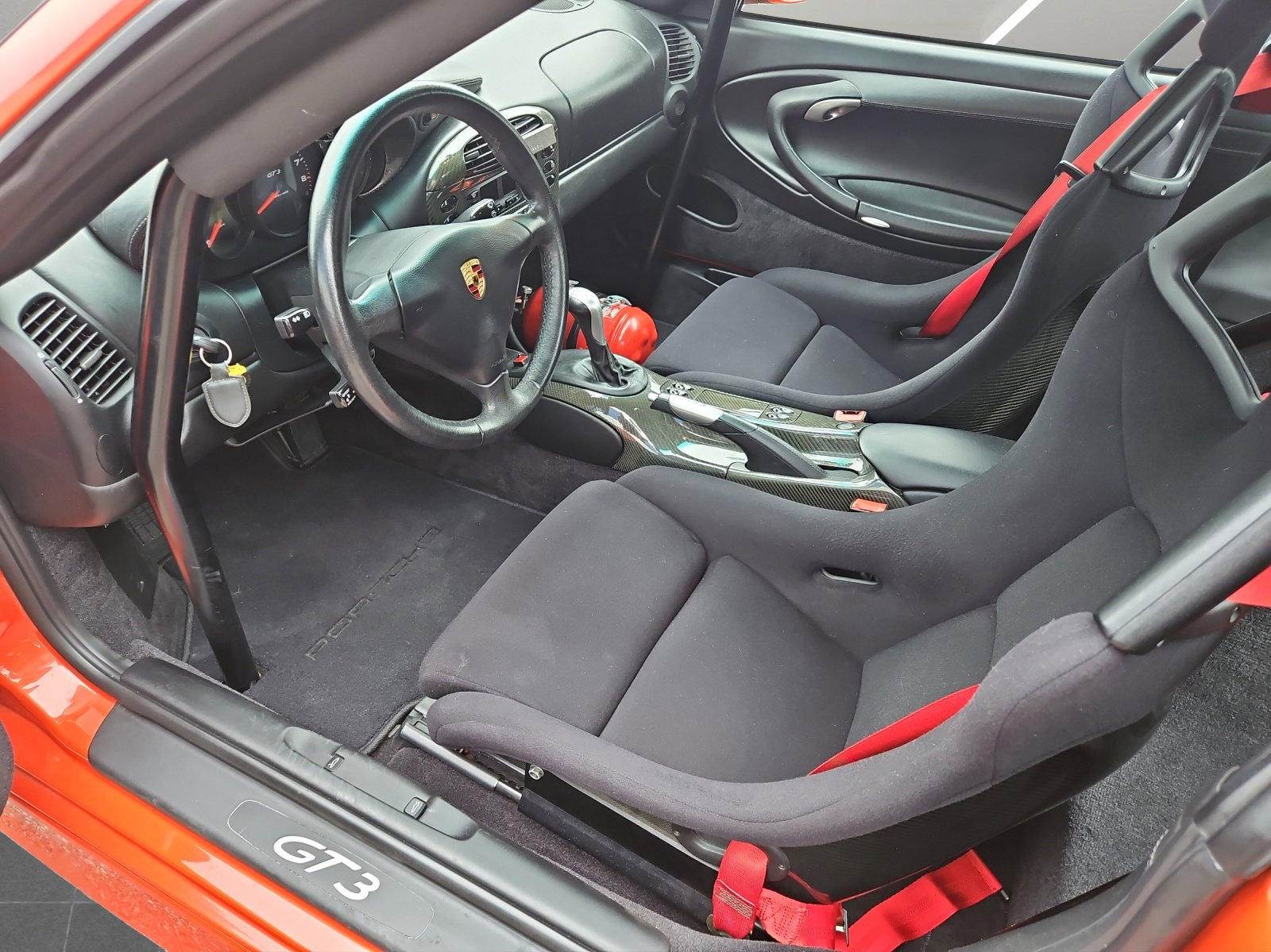
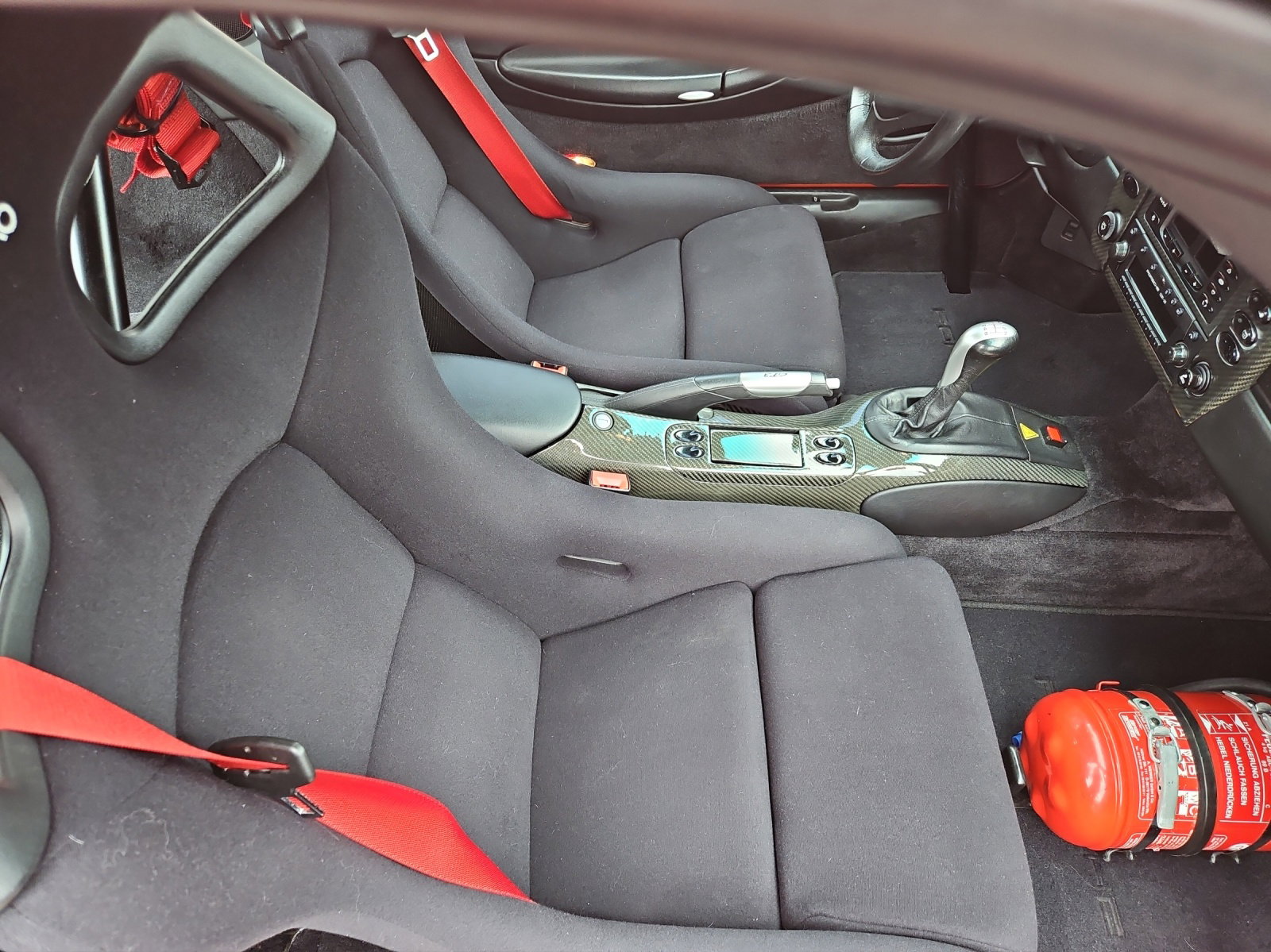
Features of the Standard GT3 Clubsport (M003) Roll cage bolted securely to the strut tower (not to the floor)
Seats: Sport bucket seats; Nomex bucket seats (fire-retardant, racing standard)
Flywheel Dual-mass flywheel Single-mass flywheel (more direct response)
Trunk lid: Steel / Carbon
Engine cover: Steel, carbon
Emergency stop switch present (center tunnel)
Seat belts: 3-point, 6-point Schroth racing harness
Fire extinguisher provided (factory-installed)
Side airbags: Present / Removed (weight reduction)
Assembly location: Zuffenhausen, Weissach (Porsche Motorsport)
Technical feature of the roll cage: The M003’s roll cage is not bolted to the
vehicle floor but is bolted directly to the strut domes. This
significantly increases the body’s torsional rigidity and improves handling—
a design that originates directly from racing and is not found on any other
road-going version of the 996.
The single-mass flywheel produces the characteristic rattling sound at idle that
Clubsport connoisseurs will immediately recognize. It ensures a more direct, immediate
engine response during acceleration—a feature that connects the driver even more closely
to the vehicle.
Production Numbers and Absolute Rarity
The rarity of the 996 GT3 Clubsport is not a marketing claim, but is substantiated by
production figures:
Porsche 996 GT3 Mk1 total: approx. 1,838–1,900 units (all markets)
Of these, Clubsport variant (M003): approx. 370–500 units (approx. 20%)
Of these, in Orange-Red Pericolor: Extremely rare (no official figure published)
With a total production of fewer than 500 Clubsport models worldwide—
spread across all markets and model years—every single vehicle is a rare
collector’s item. The 996 GT3 Mk1 is thus the rarest GT3 generation in the entire
Porsche history. By comparison: The 997 GT3 was produced in far greater numbers
; the 992 GT3 is mass-produced today.
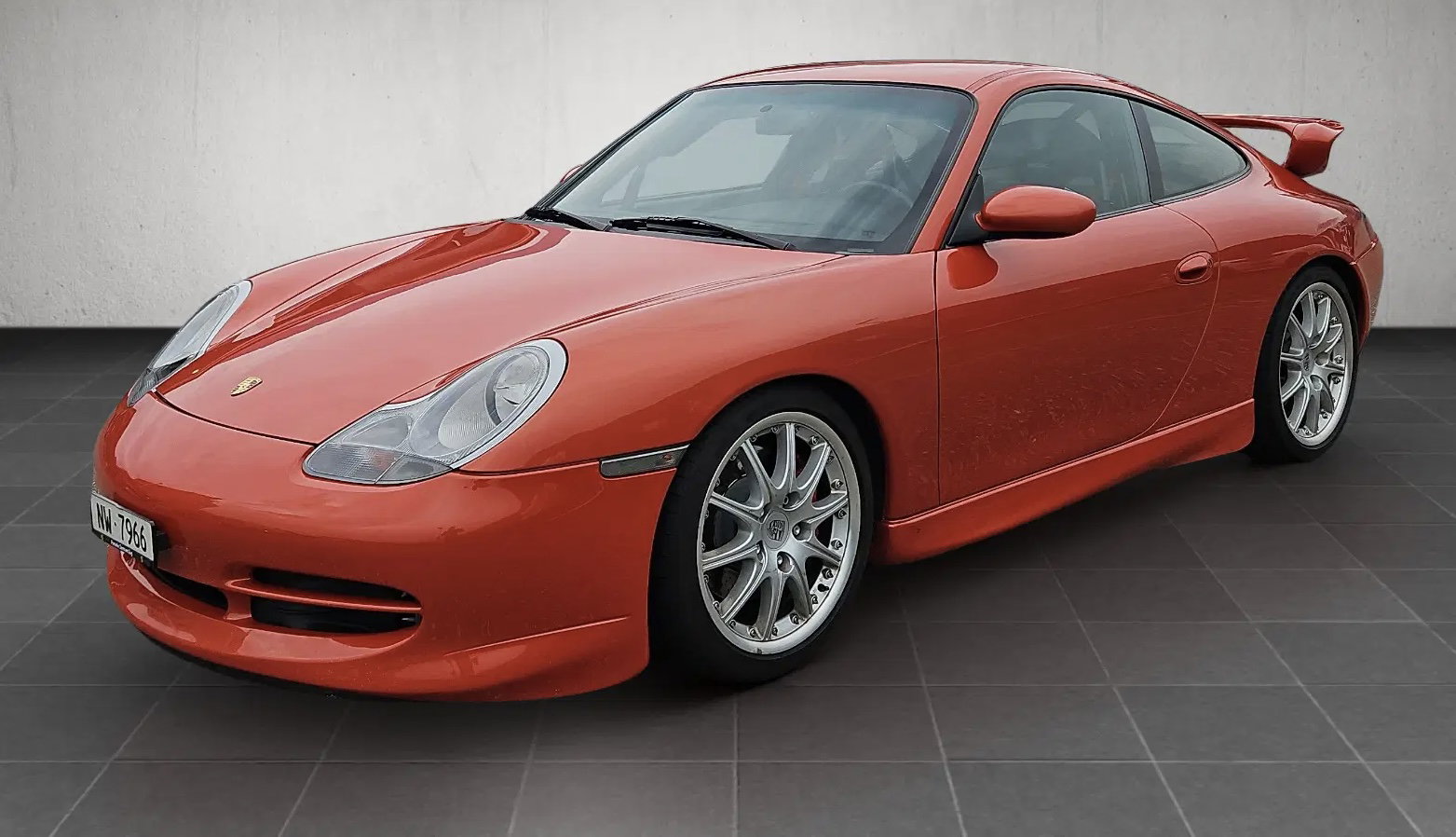
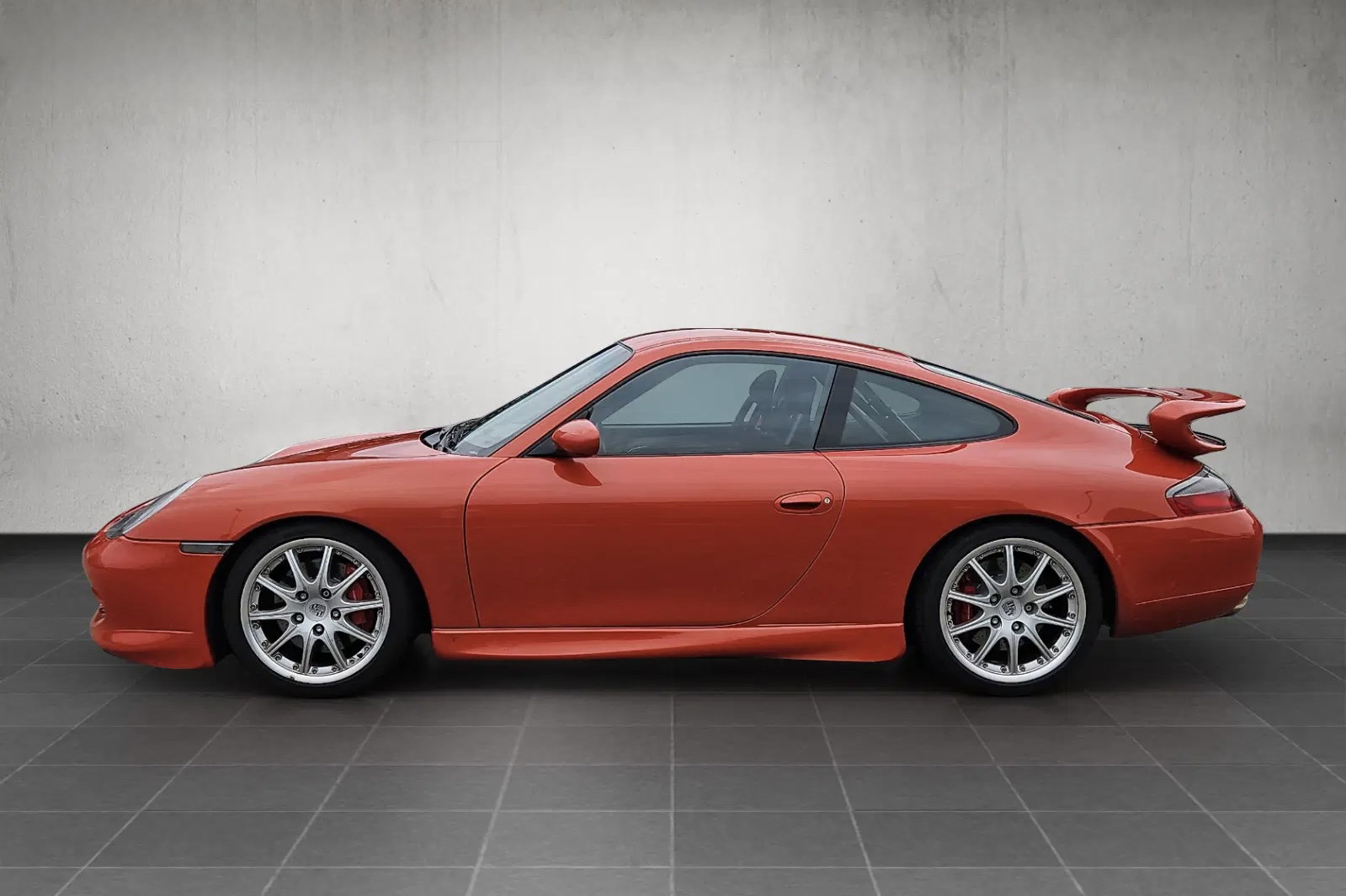
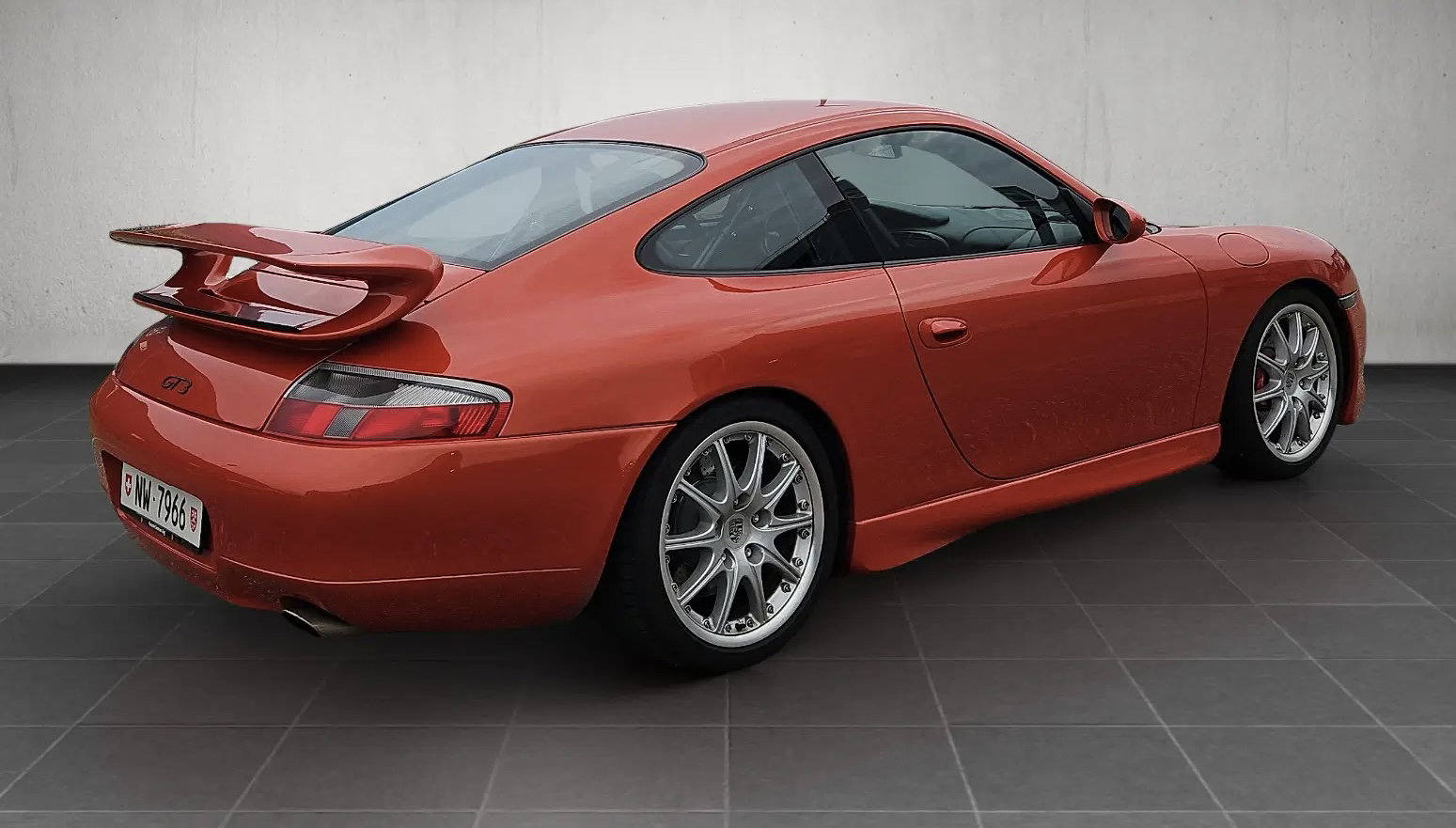
This particular vehicle is painted in the special color Orange-Red Pericolor—a
metallic color that is exceptionally rare for the 996 GT3 Clubsport. On
the Rennlist forum, the world’s largest community of Porsche enthusiasts,
it has been explicitly confirmed that vehicles in this color scheme are practically nonexistent on the
market. The color gives the vehicle a presence and uniqueness
that goes far beyond the already rare Clubsport package.
This Vehicle: Condition and History
The vehicle offered here combines all value-determining factors in a
configuration that is virtually impossible to find on the current market—
Origin: Swiss vehicle (not imported).
Single-owner for 23 years: This vehicle was first registered on April 9, 2001
and has been in the same ownership ever since. In a world where
vehicles in this class frequently change hands multiple times, such an
ownership history is an exceptional mark of quality. It guarantees
transparency throughout the entire ownership history and completely eliminates unknown
risks associated with previous owners.
Recent Vehicle Inspection: The vehicle inspection is scheduled for April 2025; it is
be free of charge and is required for operating the vehicle. For the
buyer, this means the vehicle is ready to drive immediately with no hidden follow-up costs.
Complete service history: Full maintenance documentation dating back to
initial registration is available. For a vehicle of this class and age, this is
a key factor in determining value, as it attests to the vehicle’s authenticity and the care it has received.
Compression test in March 2026 – Porsche Center Zug: As objective proof
of the engine’s excellent condition, a compression test was
by the Porsche Center Zug. The test results confirm the
excellent condition of the Mezger engine after 58,600 km:
Cylinder Measured Compression Factory Spec (New Vehicle) Deviation
Cylinder 1 13.9 bar 14.0 bar −0.1 bar
Cylinder 2 13.9 bar 14.0 bar −0.1 bar
Cylinder 3 13.9 bar 14.0 bar −0.1 bar
Cylinder 4 13.7 bar 14.0 bar −0.3 bar
Cylinder 5 13.7 bar 14.0 bar −0.3 bar
Cylinder 6 13.7 bar 14.0 bar −0.3 bar
The measured values range from 13.7 to 13.9 bar, with a factory specification of 14.0 bar when
new condition—a deviation of no more than 0.3 bar or 2.1%. This corresponds to an
exceptionally good engine condition given the vehicle’s age and mileage
and confirms the gentle use and conscientious maintenance of the vehicle over
its entire service life. The even distribution of the readings across all six
cylinders rules out localized signs of wear.



 2000
2000 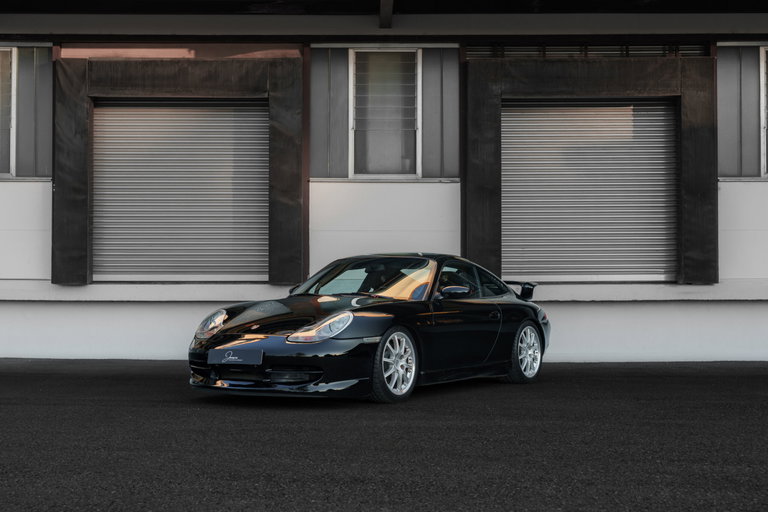
 1999
1999 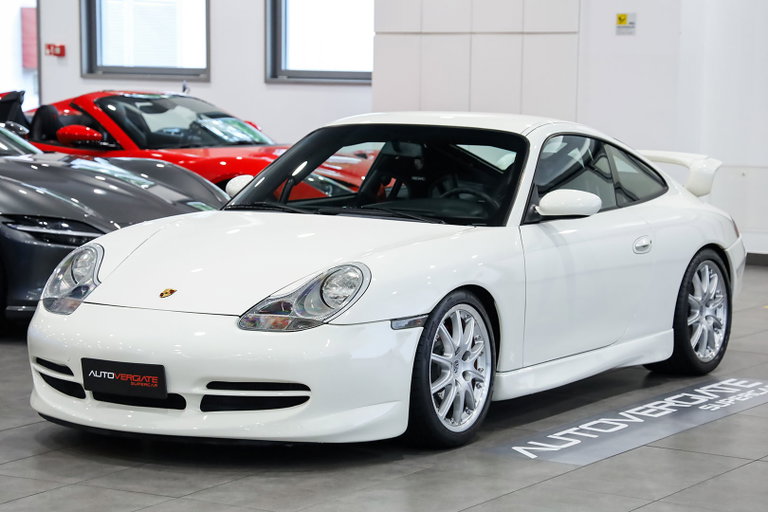
 2000
2000 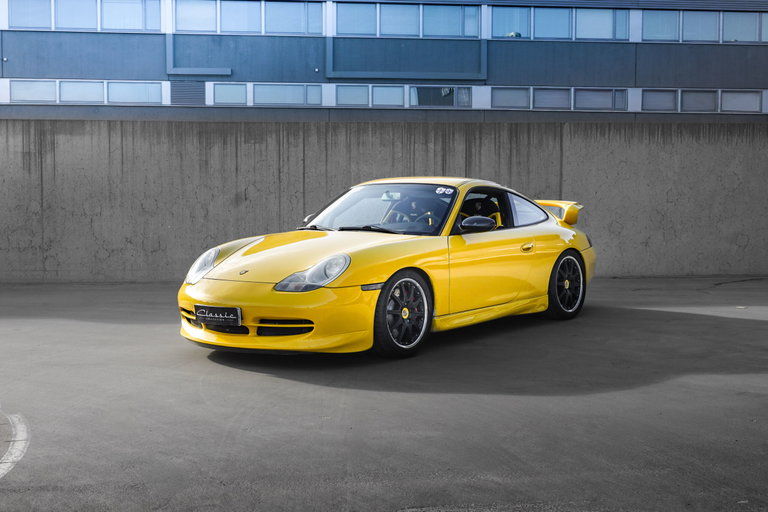
 2000
2000