The Porsche Rennsport bloodline – All 911 RS models at a glance
05.05.2026By Richard Lindhorst
Two letters that trigger boundless emotion: RS. At Porsche, this abbreviation stands for Rennsport, which means racing sport, and has been reserved for the sharpest road-legal models from Zuffenhausen since 1972. To this day, Porsche RS models have lost none of their fascination. They are emblematic of purist driving pleasure and extraordinary performance. We have summarized all road-legal Porsche 911s with the racing abbreviation in their name for you at a glance.
1972 – Porsche 911 Carrera RS 2.7 – Where it all started
It all began with the Group 4 homologation model Porsche 911 Carrera RS 2.7. Porsche developed a completely new car from a 911 S 2.4, which allowed more freedom in racing development. It was the first 911 with the nickname Carrera and the first with over 200 hp, namely 210 from the 2.7 liter six-cylinder boxer engine. This was also the first 911 with mixed wheel widths – 7J at the rear and 6J at the front – and the legendary duck tail on the boot lid. Instead of the originally planned 500 units, Porsche sold 1,580 of the 911 Carrera RS 2.7 by 1973.
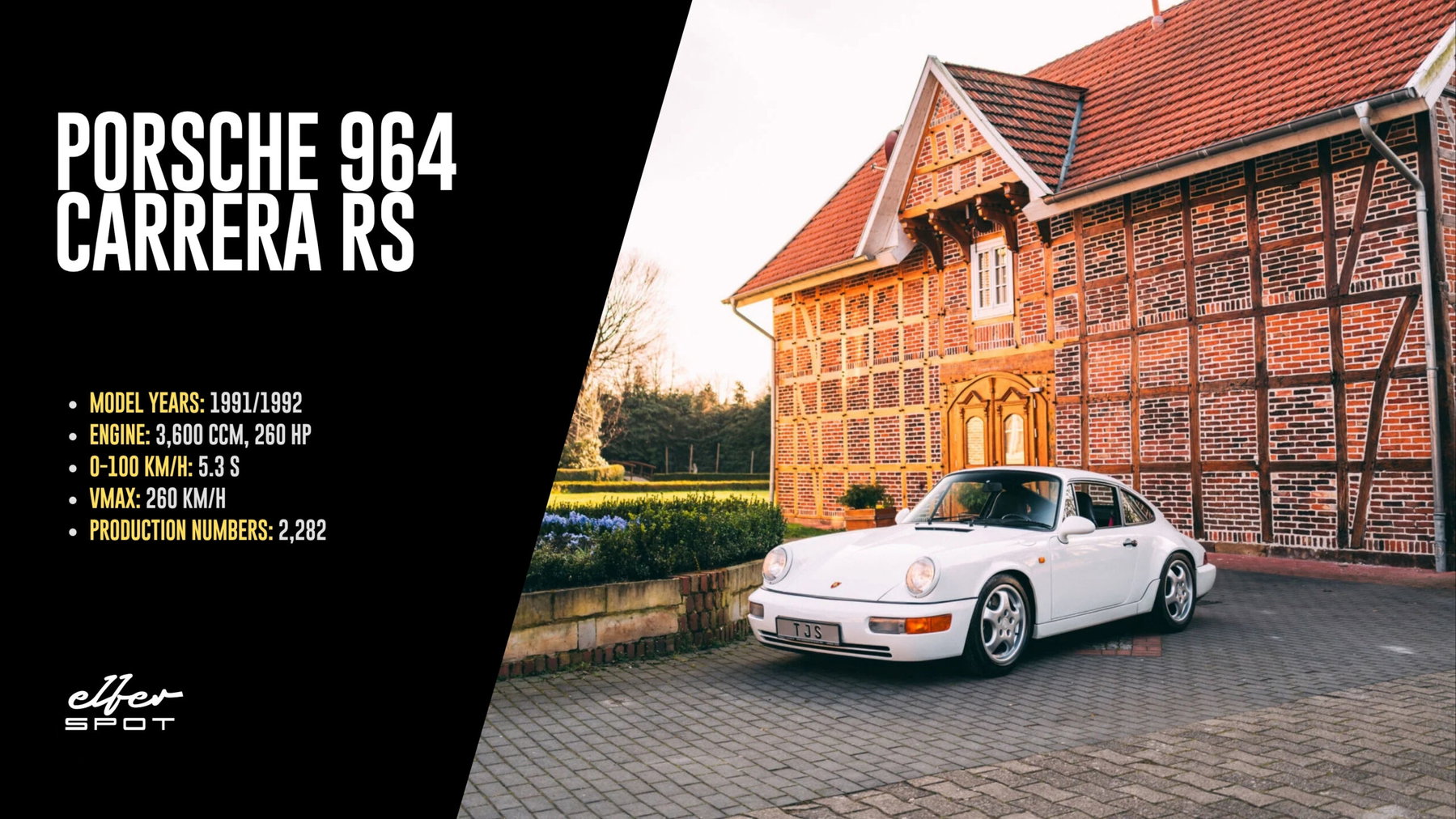
1991 – Porsche 964 Carrera RS – The allure of renunciation
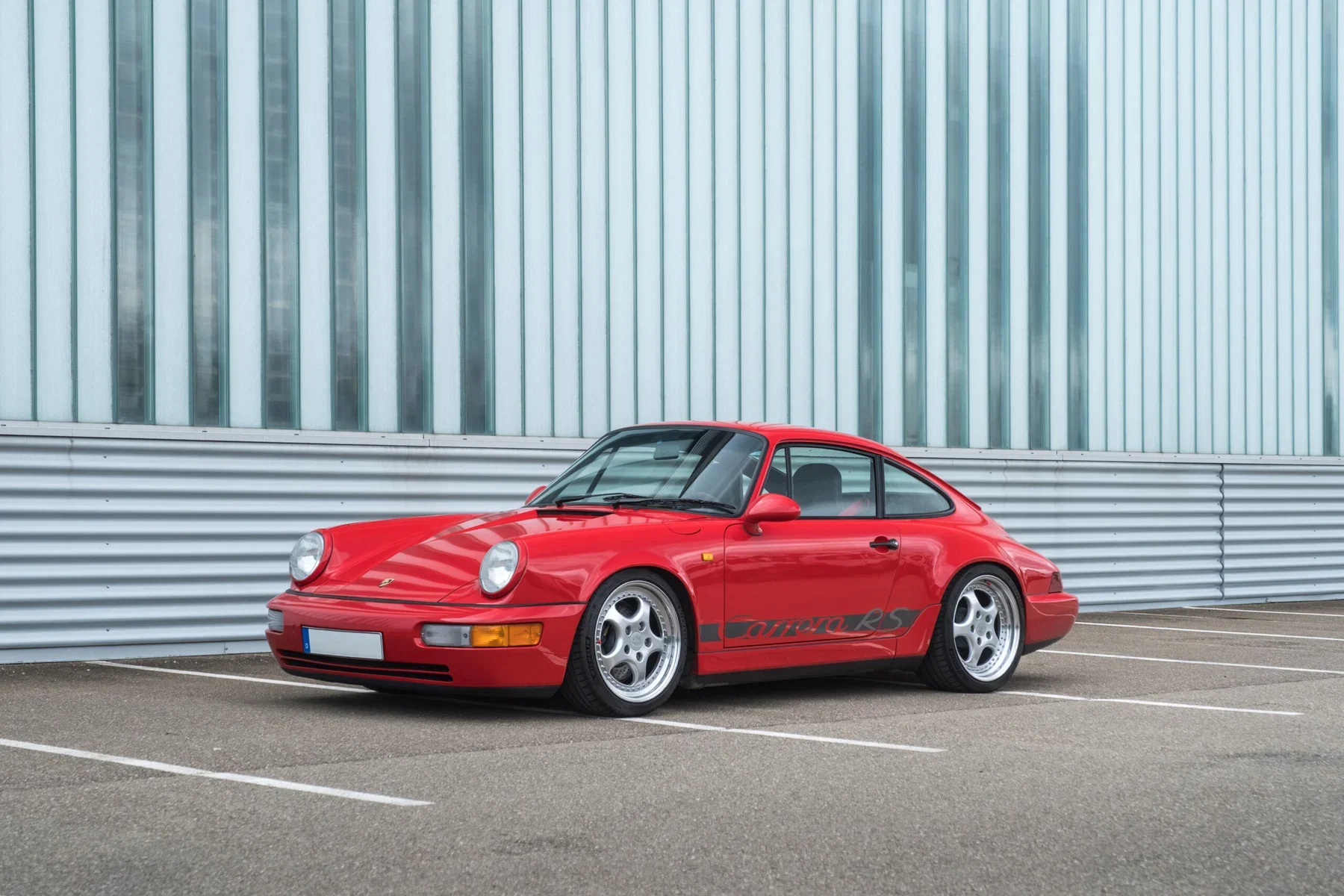
Apart from the extremely rare racing and rally versions of the 1974 Porsche 911 Carrera RS 3.0 based on the G-model and the Group B homologation model 911 SC RS 1984, it took until 1991 before the next RS rolled out of Zuffenhausen. However, the Porsche 964 Carrera RS was not a model designed for racing purposes. Instead, based on the 964 Carrera 2, it was intended to bring some racing flair to the road. Additional spot welds gave the body more rigidity, and the now 260 hp powertrain was seven kilograms lighter thanks to a single-mass flywheel, among other things. Thin glass, no power steering and many other little things ultimately saved 130 kilograms compared to the 964 Carrera 2.
When warm, there was a gearbox grinding up to 2500 rpm, which a normal person would describe as a defect.
Roland Kussmaul on driving impressions during initial tests of the Porsche 964 Carrera RS with single-mass flywheel
As with the first RS, there were several equipment variants. In addition to the regular version without any comfort, there was a touring version with sports seats instead of bucket seats and electric windows. There was also the 964 Carrera RS N/GT as a road-legal sports car. As the regular 964 Carrera RS was not available on the American market, Porsche also developed the 964 Carrera RS America. In the broadest sense, this was a Carrera 2 with 17-inch cup wheels, a firmer chassis, a rigid rear spoiler and a slightly modified interior.
1993 – Porsche 964 Carrera RS 3.8 – Homologation model for Le Mans
Porsche’s next Carrera RS, on the other hand, was once again a genuine homologation model. The 964 Carrera RS 3.8 had been designed with the clear aim of boosting customer motorsport in the newly founded GT category with near-series vehicles. The wide body of the Turbo was used for this purpose. In the rear of the lightweight 911 with aluminum doors and hoods as well as thin glass windows, a naturally aspirated engine with 300 hp was used, enlarged to 3.8 liters.
The Porsche 964 Carrera RS 3.8 is possibly the most uncompromising RS of all time.
Incidentally, the Porsche 964 Carrera RS 3.8 was the first Porsche with an engine capacity specification on the end plates of the rear wing – a trademark of the sportiest 911 models to this day. Only 56 examples of the 270 km/h RS 3.8 were built in 1993. With a new price of DM 225,000, it was almost DM 80,000 more expensive than the regular 964 Carrera RS.
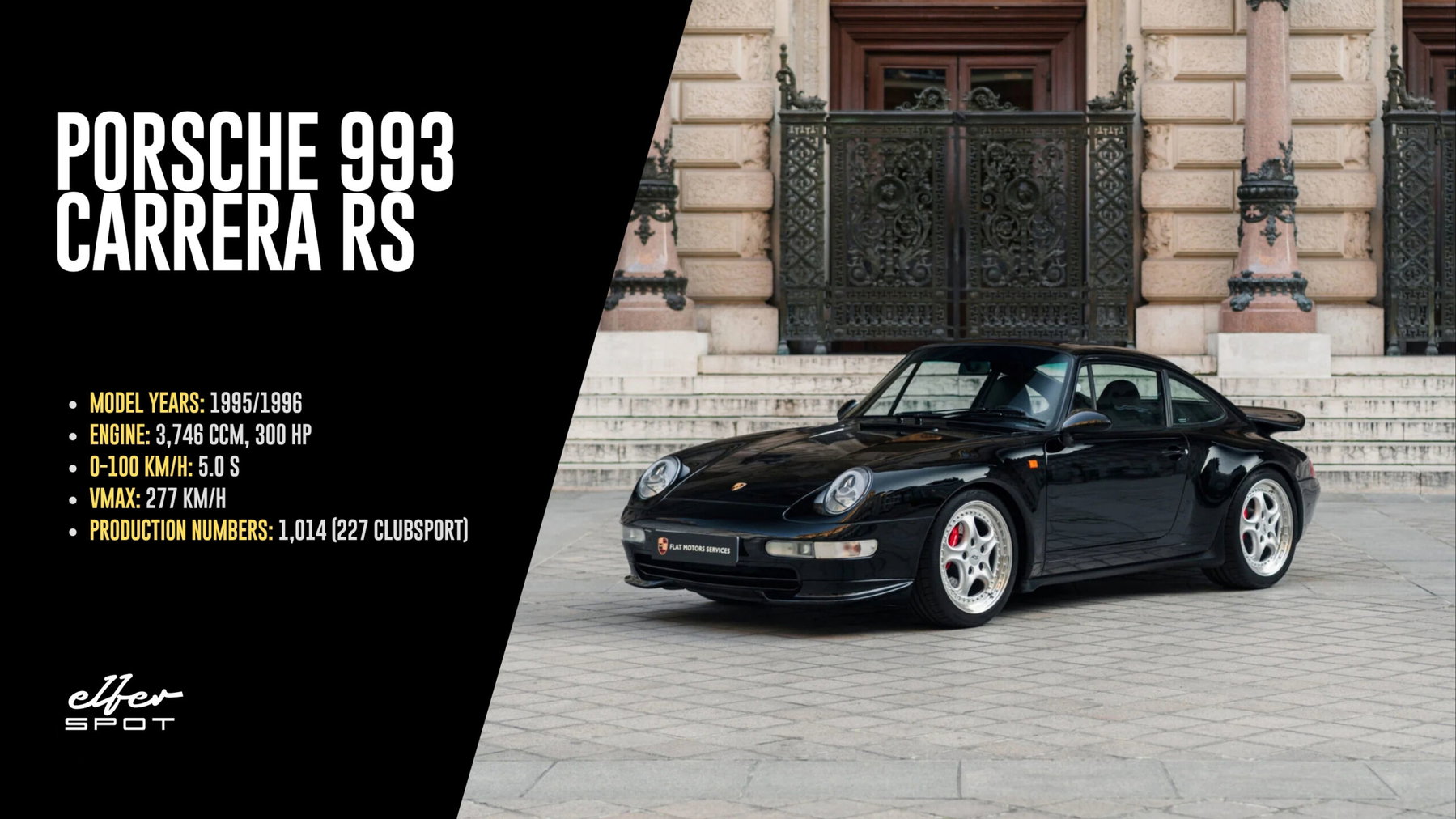
1995 – Porsche 993 Carrera RS – The last 911 Carrera RS
The last air-cooled model series of the 911 was also given an exceptional sports car with RS in its name. The Porsche 993 Carrera RS came onto the market in 1995 and was to remain the last 911 Carrera RS. With a displacement of 3,746 cc and a peak output of 300 hp, it corresponded to the 964 Carrera RS 3.8. Porsche offered the 993 Carrera RS as a Coupé and as a Coupé with Clubsport package. While the Coupé had a relatively flat spoiler similar to that of the Turbo on the boot lid, the Clubsport version had striking aero flaps at the front and a fixed rear wing with side air intakes.
Of a total of 1,014 Porsche 993 Carrera RSs produced, only 227 were delivered with the Clubsport package.
The general setup of the Porsche 993 Carrera RS was more civilized than its predecessor, though. Its chassis was not quite as hard as in the 964 and even the power steering was allowed to remain on board. For the first time, the 993 RS also offered a six-speed manual gearbox, in the Clubsport models even with shorter ratios in 5th and 6th gear than in the regular RS. Porsche built a total of 1,014 units, 227 of which were Clubsport models.
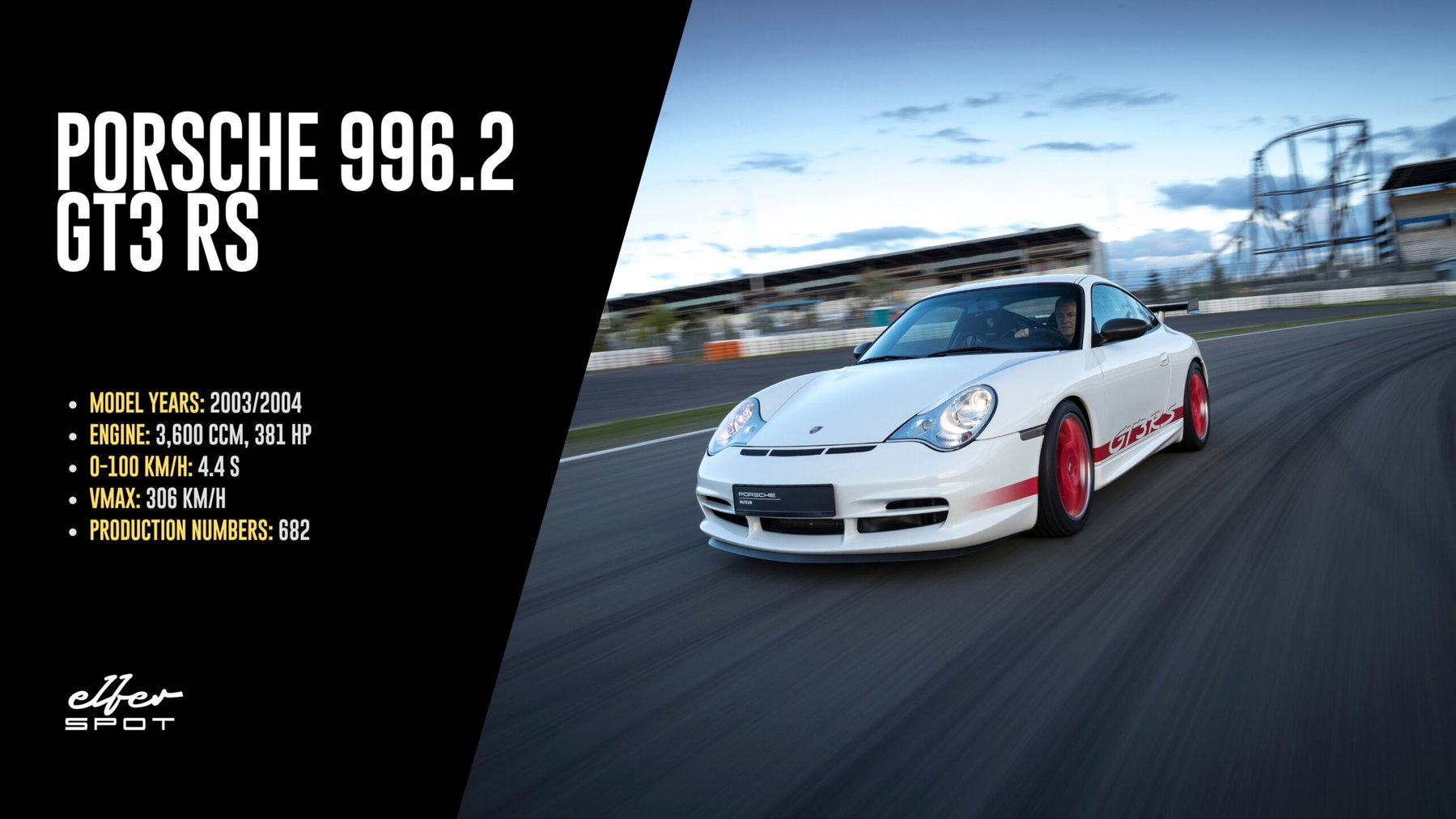
2003 – Porsche 996.2 GT3 RS – New name, even more extreme design
Following the facelift of the first water-cooled 911 generation, the first RS model of the new millennium was also launched – the Porsche 996.2 GT3 RS. It was no longer based on the Carrera models, but on the already very sporty 911 GT3. Once again, it served as a homologation model for motorsport. The cars, painted exclusively in carrara white, could only be customized from the outside with “911 GT3 RS” stickers on the side in either blue or red.
This was something like my dream project.
Andreas Preuninger, Head of GT Department
While the engine was the same as that of the GT3, the Weissach engineers changed numerous details on the chassis and body. Its front received additional cooling openings and a spoiler lip, the trunk lid was made of carbon fiber and a fixed rear wing made of visible carbon fiber completed the RS. The chassis was adjustable in terms of camber, toe and stabilizers. The 1,360 kilogram 996 GT3 RS reached 100 km/h in 4.4 seconds and accelerated up to 306 km/h. With only 682 units built, it is also one of the rarest RS models.
2006 – Porsche 997.1 GT3 RS – As wide as the Turbo, proving increasing demand for even sportier 911s
The second generation Porsche 911 GT3 RS based on the 997 relied on the familiar recipe: even lighter, even rougher and, for the first time, even wider. In contrast to the regular 997 GT3, the Porsche 997.1 GT3 RS was based on the 44 millimeter wider body of the all-wheel drive and turbo models. The RS also received special wheel carriers and wishbones on the rear axle for racing use. In terms of color, there was slightly more choice than before with black, arctic silver and the special colors orange and green. With 1,909 units sold, the 415 hp 997.1 GT3 RS demonstrated the increasing demand for particularly sporty 911 offshoots.
2009 – Porsche 997.2 GT3 RS – center lock wheels, ground effect and 8,500 rpm
The next Porsche 911 GT3 RS was based on the 997.2, i.e. the facelift version of the 997. In 2009, Porsche presented the new model with a displacement of 3.8 liters and a rev limit of 8,500 rpm. The 435 hp 997.2 GT3 RS proudly bore this displacement designation on the end plates of the carbon rear wing, just like the legendary 964 Carrera RS 3.8.
Thanks to its titanium exhaust system and center lock wheel, it was even closer to racing than its predecessors. As proof, Porsche entered a standard 997.2 GT3 RS in the 2010 Nürburgring 24 Hours and achieved a remarkable 13th place overall before the car returned to the Porsche Museum on its own wheels. Such a good result with a road-legal car will probably never be achieved again. By 2012, a total of 1,619 Porsche 997.2 GT3 RSs had been built.
2010 – Porsche 997.2 GT2 RS – Super car, redefined
This car finally catapulted the Porsche 911 into the Olympus of super cars – the Porsche 997.2 GT2 RS. With a 620 hp 3.6-liter Mezger engine, it was the most powerful production Porsche of all time. It outperformed the 997 GT2 and also the 997.2 Turbo S, which already had direct fuel injection and 200 cc more displacement, by a whopping 90 hp. But that was not all: the GT2 RS revealed just how extreme it was via its weight. Despite bi-turbocharging with variable turbine geometry, its kerb weight of 1,370 kilograms corresponded to that of the naturally aspirated 997.2 GT3 RS. Hence, the Porsche 997.2 GT2 RS, which was built 510 times and reached a speed of 330 km/h, has been one of the most sought-after Porsche models among collectors since its presentation and quite rightly enjoys legendary status.
2011 – Porsche 997.2 GT3 RS 4.0 – The last of its kind
With the Porsche 997.2 GT3 RS 4.0, Porsche launched another RS model based on the 997. It was to be the last 911 GT3 with the so-called Mezger engine. With a displacement of 4.0 liters and an incredible 9,000 rpm, it produced no less than 500 hp. The displacement figure on the RS 4.0 sticker on the door identifies it as a very special representative of its species. To this day, this last GT3 RS with a manual 6-speed gearbox is considered by many to be the holy grail. Officially limited to 600 units, it is said that a total of 613 of these racing 911s were built.
2015 – Porsche 991.1 GT3 RS – With PDK and direct fuel injection into a new era
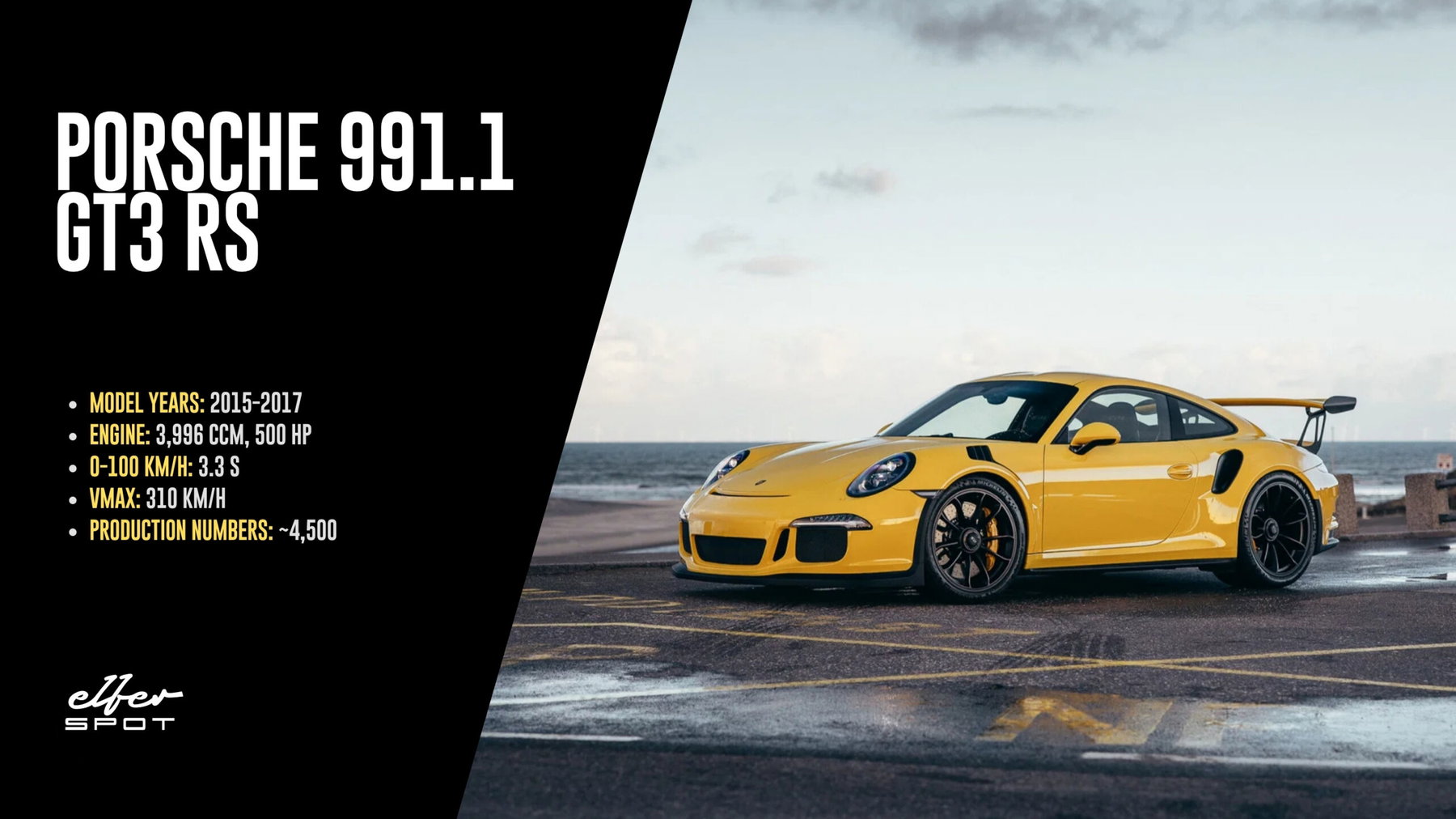
“The racing car for the racetrack and everyday life” – this was Porsche’s headline for the presentation of the 991.1 GT3 RS in 2015. With this car, Porsche heralded a turning point in the RS cosmos. An engine with direct injection was used for the first time. The 4.0-liter unit achieved 500 hp and, in combination with the 7-speed PDK, also used for the first time in the RS, enabled new heights of performance. It took just 3.3 seconds to reach the 100 km/h mark from a standing start. The vehement propulsion only ended at 310 km/h. The improved accessibility thanks to the PDK probably helped the sales figures. A total of 4,500 Porsche 991.1 GT3 RSs are said to have been built.
2017 – Porsche 991.2 GT2 RS – Thanks to 700 hp to 100 km/h in 2.8 seconds!
In the pursuit of even more power and performance, Porsche reached even higher spheres in 2017 with the 991.2 GT2 RS. The Stuttgart-based company drew a breathtaking 700 hp from the 3.8-liter DFI engine with two turbochargers. This power catapulted a road-legal Porsche 911 to 100 km/h in under three seconds for the first time. At 340 km/h, it was also ten km/h faster than the 997.2 GT2 RS. While there are no exact production figures for the 991.2 GT2 RS from Porsche directly, there are several sources that estimate production at over 1,500 units.
2018 – Porsche 991.2 GT3 RS – Classic 911 front axle for the last time, Otto particulate filter (OPF) for the first time
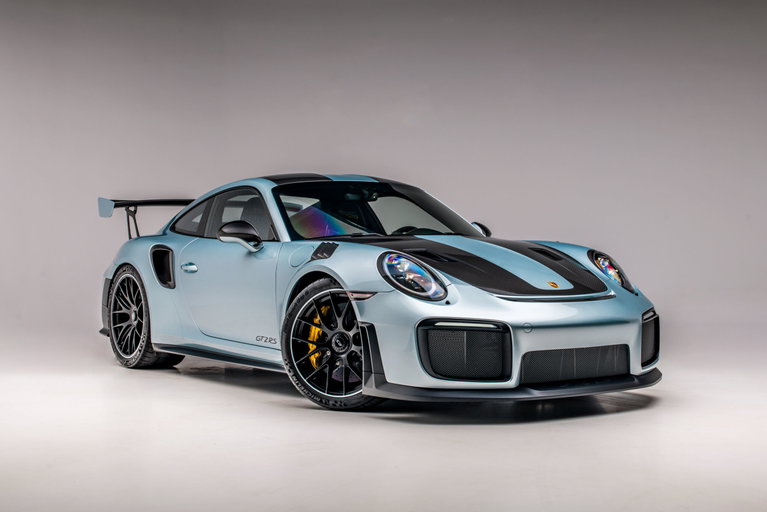
For the facelift of the Porsche 911 GT3 RS of the 991 model series, Preuninger’s team once again teased more power out of the high-revving unit. The 4.0-liter naturally aspirated engine, which only cut out at 9,000 rpm, achieved 520 hp. The first models, built until August 2018, were particularly exciting in terms of sound – they did not yet have an Otto particulate filter (OPF) installed in the exhaust tract and breathed more freely than the later models. And this was the last RS model with McPherson struts at the front. With the 992 came the move to double wishbone suspension. A total of between 4,500 and 5,000 Porsche 991.2 GT3 RSs were built.
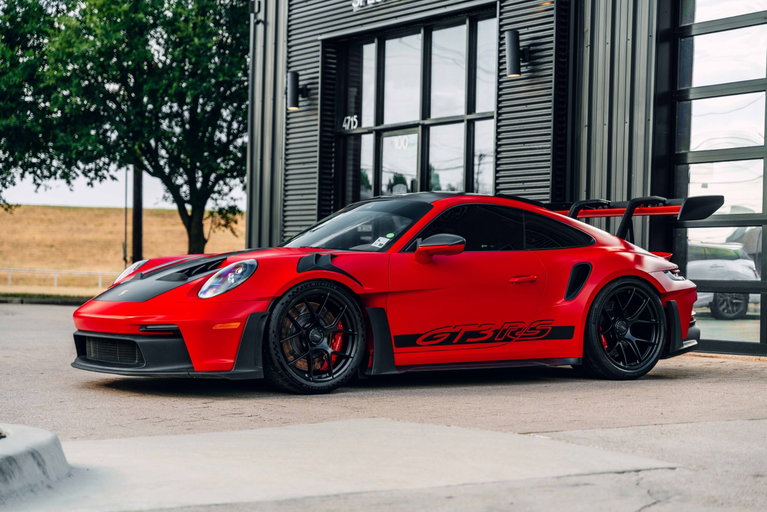
With the introduction of the Porsche 992 GT3 RS, Andreas Preuninger’s GT department transferred even more racing know-how to the road. While the engine was able to achieve a relatively small increase in power of five hp due to increasingly strict emissions regulations, the engineers in Weissach heavily focused on aerodynamics.
The customers wanted it even more extreme!
Andreas Preuninger on the background to the development of the 992 GT3 RS
A center radiator like in the 911 GT3 R and the absence of a luggage compartment opened up new possibilities in the field of active aerodynamics. Continuously actively adjustable elements at the front and rear provided a total of 409 kilograms of downforce at 200 km/h. These values were twice as high as those of the predecessor and three times as high as those of the 992 GT3 on which the RS was based. There are still no reliable production figures, but it is assumed that the figures will be even higher than those of its predecessor. That would mean over 5,000 992 GT3 RSs produced.
There are certainly faster, more expensive and louder cars. But Porsche’s RS models have stood for the best implementation of the “racing car for the road” concept for over five decades.
Message
Do you have a tip for a story or just want to get in touch with Richard?








 2018
2018 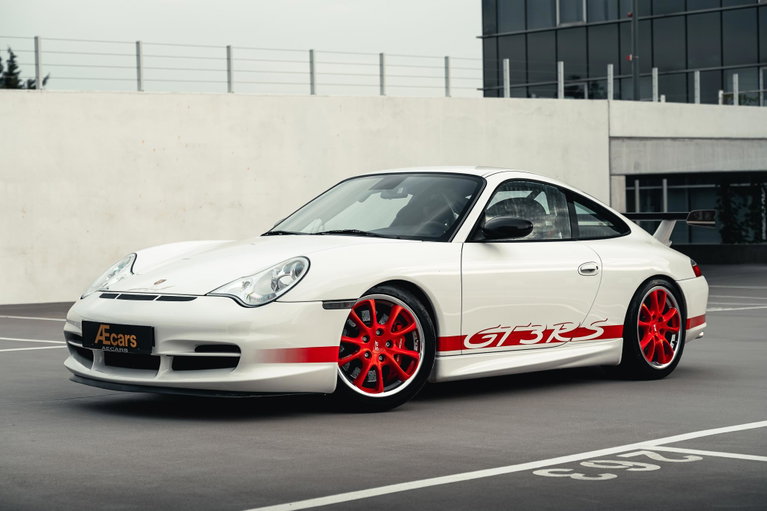
 2004
2004